It’s getting hot in here
Is our electric grid here to serve us? Or the machines?

This week, a “mega heat dome” settles over the Eastern Seaboard. By Thursday, 233 million Americans will see temperatures above 90°F. Washington hits 105. New York sits at 102 for two straight days heading into the Fourth of July. Boston touches 100. It’s the kind of stretch where air conditioners run nonstop for days, because stopping isn’t really an option for a lot of people, it’s a matter of safety.
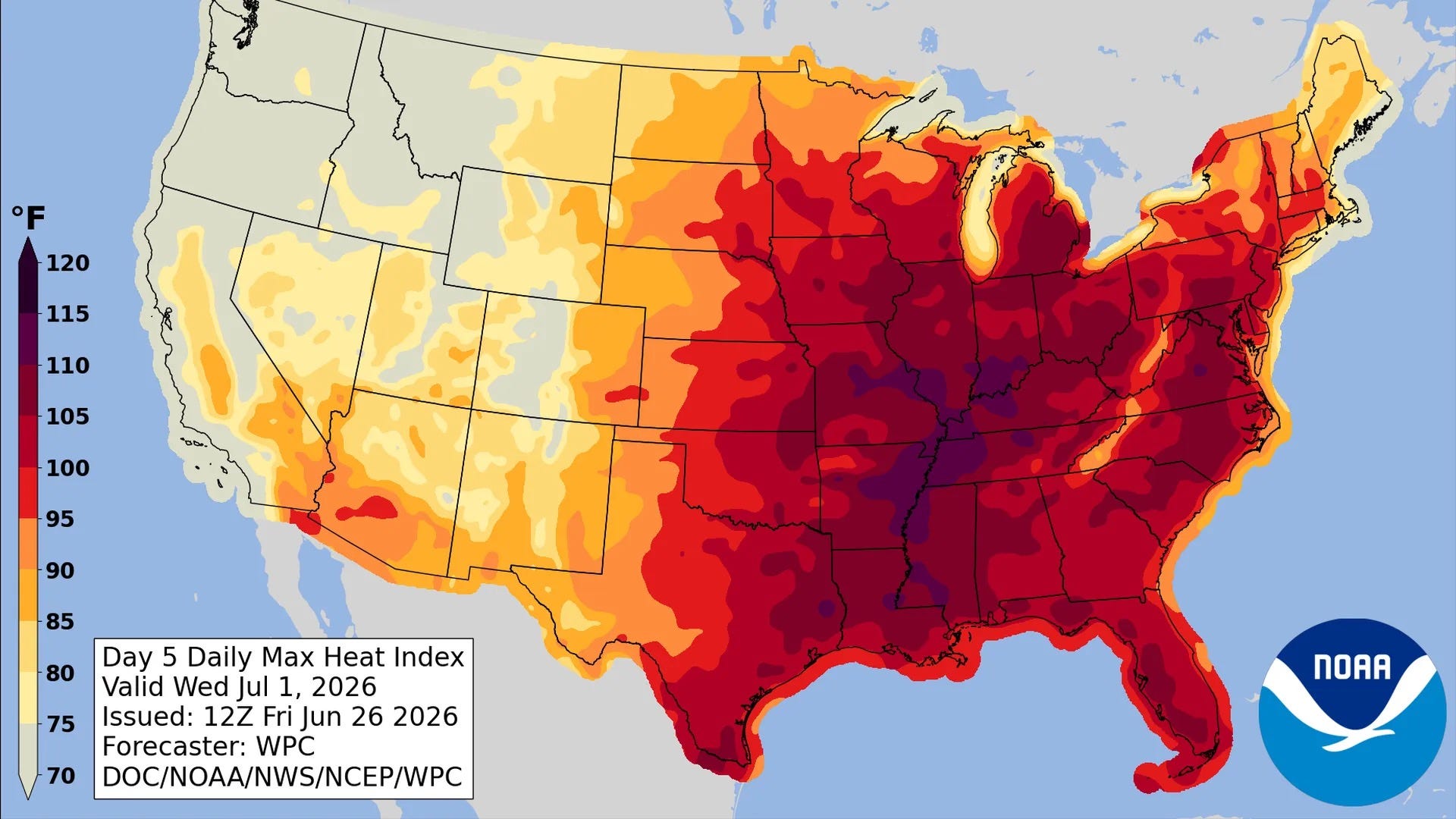
At the exact same moment, in counties across the country, those same people are fighting to keep data centers off their land.
These two facts are not unrelated. They are the same story.
PJM
PJM Interconnection manages the largest electricity grid in the United States, serving 67 million people across 13 states and Washington, D.C. This week, amid the heat dome, PJM is projecting electricity demand that could surpass its all-time record, set in 2006.
The reason the record is in danger isn’t just the heat. It’s what’s already on the grid before the heat arrives.
PJM’s own independent market monitor concluded that data centers were responsible for 63% of the increase in electricity capacity prices in 2025/2026. That’s $9.3 billion in costs passed directly to customers in higher electric rates in a single year. Capacity prices have more than 10x’d from roughly $29 per megawatt-day in 2024 to $329 per megawatt-day in 2026/27. Starting this month, ratepayers across the PJM region are paying an additional $1.4 billion annually in capacity market costs, driven largely by data center demand.
PJM has also acknowledged that its grid is essentially full. Starting this summer, it has just enough power to maintain reliability. Data centers are connecting faster than new supply can be built. PJM currently has no authority to stop those connections — data centers are allowed to plug in even when there isn’t enough electricity to go around. By June 2027, the region may fall below reliability standards. That means a greater risk of rolling blackouts, especially during heat waves exactly like this one.
This isn’t a projection. It is the grid operator for the Eastern United States saying, in official filings, that data center demand is the primary reason for tight supply conditions and record consumer prices.
The Floor is Gone.
The energy markets confirm it in real time.
ICE daily PDP futures contracts on PJM West Hub, the benchmark pricing point for the mid-Atlantic grid. Pre 2026, those settled above $487 per MWh three times. Two were December 23rd and 24th, 2022 when winter storm Elliott hit without warning and caused grid emergencies across the Eastern US. One was a summer 2022 heat event. It was always on the last trading day when traders came face to face with weather’s reality. Nobody saw them coming days out.
In 2026 we’ve exceeded $487 twenty times already and not just on the final trading day. Today, July 3rd is already trading above $487. The market is pricing extreme stress in advance because everyone can already see the math. The grid has so little headroom that a heat wave produces the same price signals as a historic winter emergency, and does it days early because the constraint is structural, not seasonal.
In 2022, prices at this level meant a catastrophic surprise. In 2026, they mean a Tuesday in late June when it’s going to be hot.
The difference isn’t the weather. It’s the floor, the permanent, 24/7, never-stops, doesn’t-care-what-season-it-is data center load that has consumed every gigawatt of headroom the grid used to have for exactly these moments.
When your power bill spikes this weekend, it’s not the heat dome doing it. The heat dome is just the trigger. The data centers loaded the gun.
Who is it all for?

The people who built these AI companies spent years telling us — from conference stages, in newspaper profiles, in congressional testimony — that AI was going to take our jobs. They said it openly. They were proud of it. Dario Amodei, CEO of Anthropic, recently described a scenario of 5-10% GDP growth alongside 10% unemployment as “not impossible.” The CEO of AWS announced tens of thousands of layoffs while simultaneously launching an AI recruiting tool that interviews candidates with no human involved.
They told us the jobs were going.
Now those same companies are bidding against us for power. Power that they consume at gigawatt scale. More power than we consume in massive cities. It’s the reason why they are here, they need the power. Power from a grid the American public built over the course of a century through utility bills, municipal bonds, and rural electrification programs to feed something that will take jobs from the American public.
This 4th of July weekend, ordinary families are competing against data centers for the electricity that will keep their elderly parents cool in 105-degree heat. That will keep their pregnant wives comfortable. That will keep their children safe.
For what? So the AI that is coming for your job can keep running.
That is the deal on the table. You subsidize the infrastructure. You absorb the price increases. You lose the job. They keep the AI.
The dominant response from the industry has been that this is a PR problem: people just don’t understand the benefits, AI companies need community tours and listening sessions. But the PJM numbers aren’t a perception issue. $9.3 billion in extra costs passed to ratepayers in a single year isn’t a messaging failure. It’s a transfer of wealth, from the American people who built the grid to those who want to consume it to train their models that will take jobs from those same American people.


What’s the fix?
The fix isn’t complicated. It isn’t a ban on AI or a rejection of technology. It’s the principle every other capital-intensive industry has to live by: pay the full cost of what you consume. Build your own generation. Don’t jack up the power bills of the people who built the grid so your servers can run cool while their houses bake.
Theodore Roosevelt — who broke up the railroad trusts and the oil monopolies — said it plainly over a century ago: “The rights of the public to the natural resources outweigh private rights, and must be given its first consideration.” And he was equally clear about who the obstacle was: “Our duty to the whole, including the unborn generations, bids us restrain an unprincipled present-day minority from wasting the heritage of these unborn generations.”
He wrote that in 1912. It fits 2026 perfectly.
PJM projects that peak demand will grow by 32 gigawatts from 2024 to 2030. All but 2 gigawatts of that growth comes from data centers.
This week, in 105-degree heat, with the grid at record strain, those numbers stop being abstract.
When this bill come’s due, it will like always be the American people who are on the hook to pay it.